

Red flag
Who decides if Lenin is illegal? The Czech Republic’s new memory war

It’s May Day. The cherry trees on Prague’s Petřín Hill are in full bloom. Lovers are embracing in the sunshine. And somewhere, a young policeman is deciding whether the guy in the Che Guevara T-shirt is breaking the law.
I exaggerate. But perhaps not by much.
For no-one really knows what will happen today, the first May Day since Czech anti-extremism legislation was tightened to explicitly include communist movements and associated symbols.
Article 403 of the Criminal Code has now been amended with the following addition (in bold):
Whoever establishes, supports or promotes a Nazi, communist or other movement which demonstrably aims at suppressing human rights and freedoms, or proclaims racial, ethnic, national, religious or class hatred, or hatred towards another group of persons, shall be punished by imprisonment from one year to five years.
Article 404, meanwhile, which deals with public sympathy for such movements - waving flags and carrying signs etc - has similarly been tightened, with prison sentences of up to three years.
“Czechoslovakia experienced two totalitarian regimes in the 20th century - Nazism and Communism,” said historian Kamil Nedvědický, First Deputy Director of the Institute for the Study of Totalitarian Regimes (USTR), who advocated for the legal change.
“Both have been condemned by law as illegitimate and criminal systems that caused suffering to millions of people,” he told me at the USTR’s offices in Prague.
“But the criminal prosecution of those people promoting these totalitarian regimes has not been the same,” Nedvědický explained.
“Those who sought to defend or minimise the crimes of Nazism have been - rightly - prosecuted and punished. But defenders and promoters of Communism and Communist symbols were not prosecuted in the same way,” he went on.
This amendment, he says, removes any leeway.
Police - and courts - may now have to respond.
But what does that mean exactly? Is brandishing a copy of the Communist Manifesto illegal? What about waving the present-day flag of China? Or wearing a Che Guevara T-shirt?
“There will always be borderline cases,” Kamil Nedvědický answered.
“With Che Guevara, we’re speaking about a pop-cultural symbol, but also someone who actively participated in building a totalitarian regime in Cuba and tried to spread it elsewhere,” he added.
“Courts will have to decide such matters - whether it was merely a cultural reference or a conscious and deliberate promotion of a totalitarian regime.”
The flag of China, meanwhile, will be exempt, as displaying official state symbols of countries recognised by the Czech Republic cannot in itself constitute a criminal offence.
Waving the flag of the Soviet Union, however - that could land you in court.
Pity the poor copper who must thumb through the police handbook (there is one, apparently) for the answer.
“Nothing is clear,” said Professor Miroslav Mareš, one of the country’s leading experts in political extremism, who believes the legal amendment is flawed.
“We can discuss the scope of freedom of speech. We should of course discuss the crimes of Communism. But I think this amendment just wasn’t drawn up properly,” he told me.
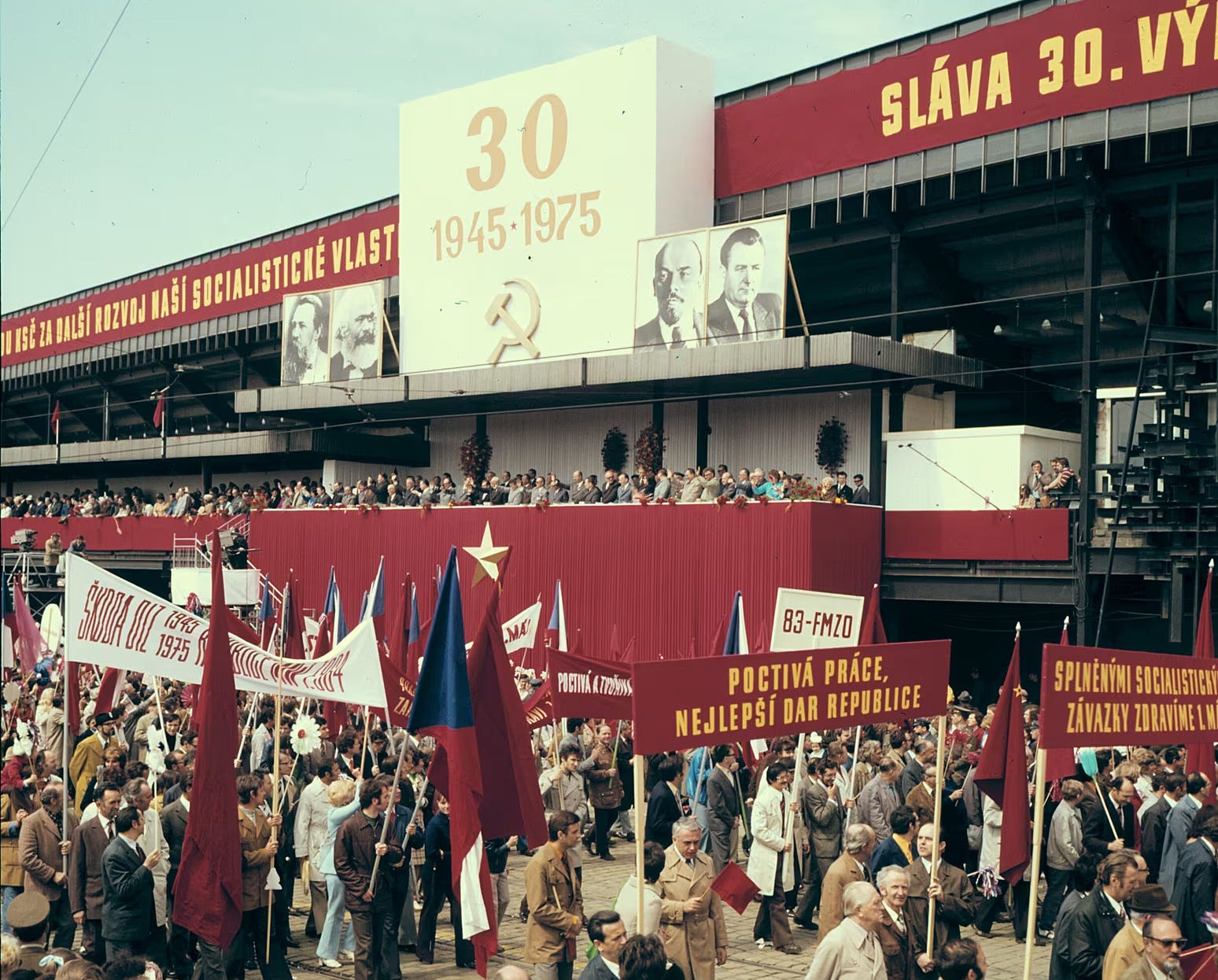
May Day celebrations on Prague’s Letná Plain, 1986 (five days after the Chernobyl accident)
“Do you know who were the last ones to ban the Communists? To eliminate the Communists? The Nazis,” said Kateřina Konečná, leader of the Communist Party of Bohemia and Moravia.
“And it started in exactly the same way: they weren’t allowed to use certain symbols, they were monitored and so on,” she told TV Prima News after the amendment was approved by parliament last year.
“It’s total stupidity. It’s a complete denial of all historical facts.”
Konečná said the party’s lawyers had assured her the Communists were safe from any legal action.
Nedvědický told me that in fact books with images of Lenin had already been removed from the display window of the Communist Party bookshop for fear of falling foul of the law.
Marx, he said, was still there.
Indeed, the bigger threat to the Communist Party is political - not to mention demographic.
The Communists made a failed bid to re-enter parliament last year under the Stačilo! marketing project, falling short with just 4.3% of the vote.
Membership, meanwhile, has shrunk from 750,000 in 1990 to 15,000 today.
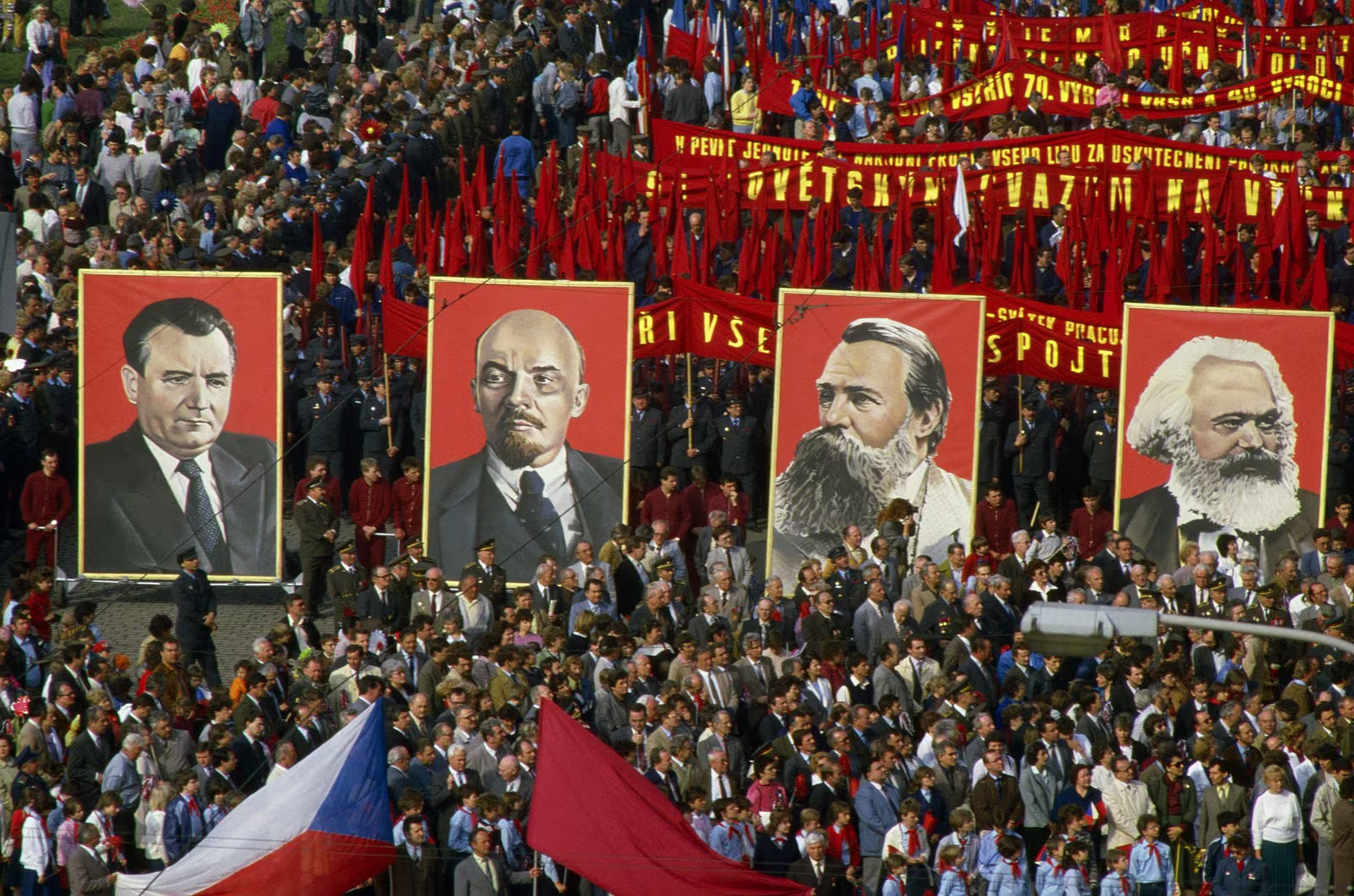
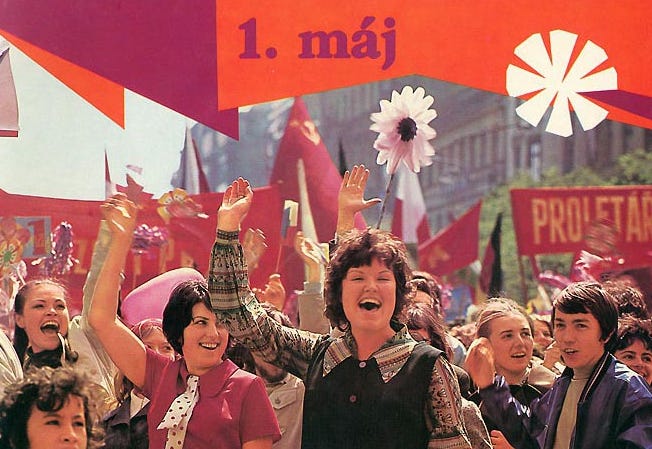
May Day rallies before 1989 once filled Prague’s Wenceslas Square and later Letná Plain. Attendance was often mandatory, or at least heavily encouraged by the state.
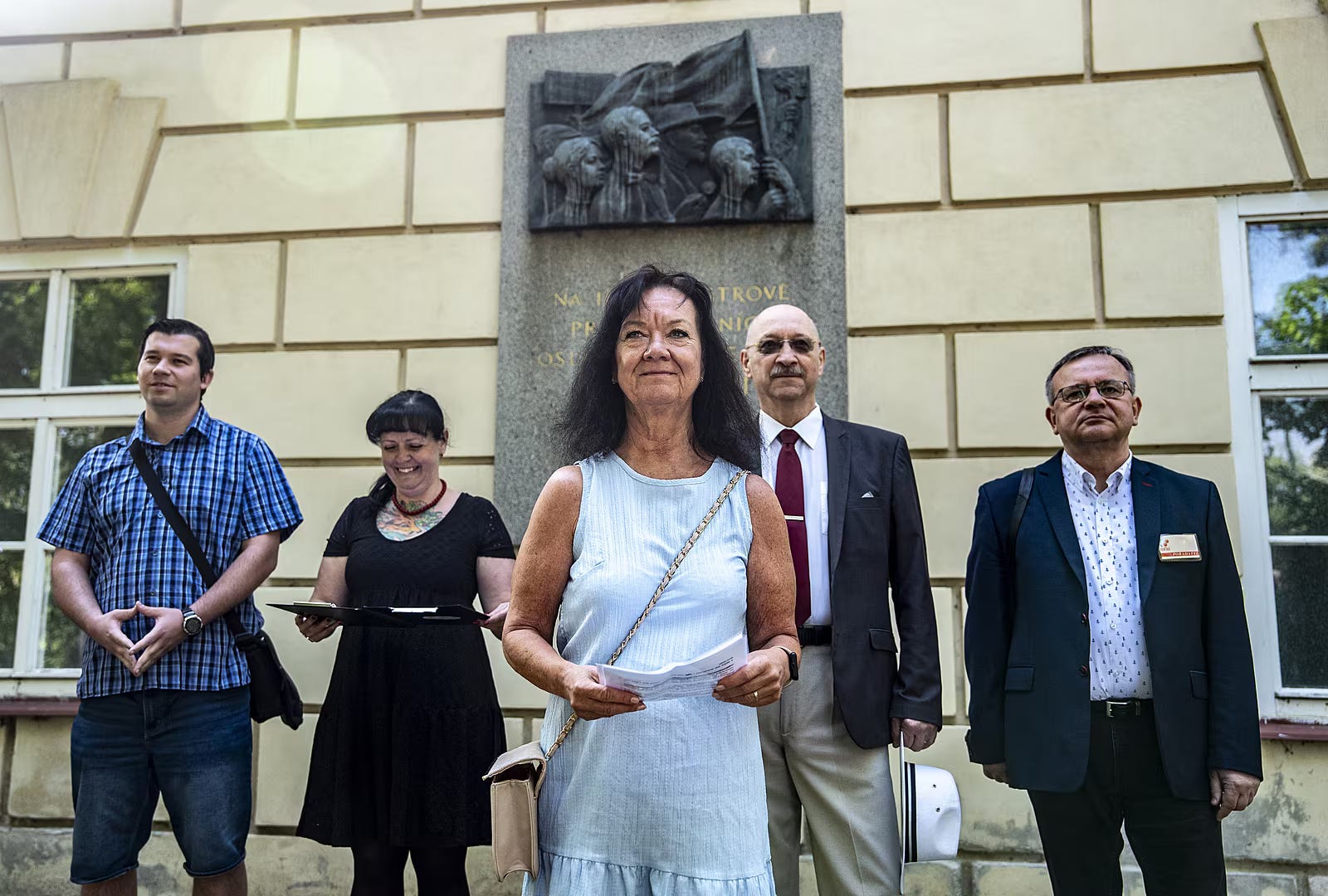
These days, the Communist Party gathers in the more modest surroundings of Střelecký ostrov, an island in the River Vltava. Each year the numbers dwindle.
They take turns with the equally diminished Social Democrats (rebranded as SOCDEM) and anarchists.
In truth, all three groups could fit there comfortably at the same time.
Few Czechs give much thought these days to the striking workers of Chicago in 1886. For most, May Day is celebrated as a day of romantic love, as extolled by the 19th century Czech poet Karel Hynek Mácha in his Máj. It remains a public holiday.
Once the Communists filled Prague’s grand squares. Now they share an island.
History can be cruel.
The collapse of Communism in November 1989 opened the gates to thousands of curious foreigners, including myself. Some stayed a few months. Some a few years. Others, like me, made Prague their home, and are now Czech citizens. Here’s my story:
The Brexit insurance policy

I became a Czech citizen mostly to Brexit-proof my life. I thought I was making an entirely practical decision. It turned out to be a lot more meaningful than that.
Brilliant in today's context. Thank you.
Peak centrist politics?